( by Endurance.net)
Mary Lutz, Director of Endurance for the United States Equestrian Federation (USEF), has verified that recent changes in FEI policies have led to the cancelation of the scheduled 2007 Pan American Endurance Championship.
In the past, FEI has viewed the United States as being composed of 5 Zones and Canada as composed of 2 Zones. Each of these zones has been treated as a "country" with respect to entry into the Continental (North American) and Intercontinental (Pan American) Endurance Championships.
The recent FEI policy change results in United States and Canadian representation in Intercontinental (Pan American) Endurance Championships being limited to 6 individual participants, one team, from each participating National Federation - plus 6 additional individual participants from the hosting federation.
This effectively means that Pan American Championship events, when held in North America, will have a smaller field of competitors. (a total field of 18 individual riders, two teams, from United States and Canada).
In addition, each Central or South American country that participates may field 6 individuals, one team, - but given the expense and logists of competing in North America, South American participation is usually minimal.
This effect has led the Organizing Committee for the 2007 Pan American Championship in Manitoba to withdraw their bid. They are concerned that they would not be able to cover the expenses of hosting a Pan American Championship with a greatly reduced number of ride entries.
FEI is currently negotiating with Brazil as a possible alternative to the Canadian venue for the event.
North American Federations are considering hosting a North American Endurance Championship in 2007 instead of a Pan American Endurance Championship. (the FEI policy limiting entries to 6 per non-host Federation do not apply to Continental Championships).
Further information will be forthcoming from FEI and National Federations of the effected countries.
Tuesday, April 25, 2006
Monday, April 24, 2006
Tall (and long) in the saddle

By Don Sapatkin
Inquirer Staff Writer

Photo by David M Warren/Inquirer. Song (left) and Danika watch as Melody Blittersdorf, of Jeffersonville, Vt., prepares food and supplements for them between the second and third loops of an endurance race in the New Jersey Pine Barrens. Blittersdorf's daughter, Krista Alderdice, rode Danika, who won the award for best condition.
Links: Endurance riding info and a photo slide show
Nancy Botella poured Log Cabin Syrup into Ruby's bucketful of oat, beet pulp and electrolyte mush.
"You've got to eat, lady, eat some grains!"
The tactic might have worked earlier that Sunday morning, but with 31 trail miles behind her and 19 to go, the horse nibbled with the enthusiasm of a novice marathoner offered pancakes at the two-thirds mark.
Endurance riding is the equestrian equivalent of long-distance running.
Riders, like runners, often enter the high-mileage events with a goal of simply finishing. Overall conditioning, pacing, and the common sense not to do anything stupid are as important as pure athleticism.
And distance riders get the bonus of working as a team.
"Ten. OK, up and back," directed veterinarian Meg Sleeper, calling out Ruby's 15-second pulse before a 250-foot round-trip trot. Medical safeguards are built into endurance events, and a recheck one minute later found Ruby's pulse unchanged at the equivalent of 40 beats per minute, a good rate of cardiac recovery.
The vet moved around the horse, pinching (a dehydration measure), listening (to gut activity), looking (for fatigue or injury). An assistant marked Sleeper's findings on a card that resembled a rental car no-ding diagram with a horse.
Ruby refused to open her mouth for the doctor.
"It's because she was abused," explained Botella, her face sunburned after two of the day's three loops of trail in the New Jersey Pine Barrens. "She was terrified when I got her."
Botella, who has had horses since she was a child in Glen Mills, knows nothing of Ruby's past, except that she was "rescued from a slaughterhouse herd" 12 years ago and is of mixed ancestry. (Endurance is dominated by Arabians.)
"I love going out on the trail," said Botella, 47. "You have a partnership with your horse."
Three weeks ago, she drove Ruby, 14, to the Pinelands for their second endurance ride, a 50-miler.
Horses, trailers, and women in tights filled the campsite behind the Kowboy Korral in Maxwell (north of Green Bank and south of Jenkins). For reasons that no one seems to understand, in America nearly all endurance riders are women. They were 28 of 31 starters that day.
"You can set your own goals is the reason I like it," said Patti Pizzo, who organized the three-day event (riders entered any one, two or all three).
Pizzo, who is 55 and partway through a move from the Doylestown area to Upper Black Eddy, devises a new course each year while riding the sandy trails over the winter. She was tickled this time to send riders past a Christmas tree 50 feet off the trail that someone decorated two years ago.
Pizzo got her first horse, a $50 gift from her father-in-law, a few years after graduating from Cheltenham High School in 1967. Endurance was barely beginning, out west.
A governing body formed in 1972. Endurance became the U.S. Equestrian Team's fifth discipline in 1993. Relatively unknown because it is not a spectator sport, the American export is the fastest-growing equestrian category worldwide.
While Botella pleaded with Ruby to eat her syrup-laced electrolytes, a mother-daughter team from Vermont organized their mandatory rest between trail loops like a seasoned pit crew: ice boots on the front legs; protective boots on the rear; baby food, electrolytes, apples, carrots and amino acids in the buckets.
They endured together and tied for first place with a riding time of 5 hours, 23 minutes. Botella clocked in at a respectable 7:37, ranking 16th among 24 finishers; seven starters had been taken out by vets along the way.
The award for best condition went to Danika, the 13-year-old half-Arab ridden by Krista Alderdice, 29, of Jericho, Vt.
Mother and daughter might have faced tougher competition if Sleeper, 38, had been riding Shyrocco Troilus instead of playing doctor that day.
She bred Troy 15 years ago, choosing a name that reflected his Anglo Arabian ancestry and her love of Chaucer. He carried the University of Pennsylvania veterinary cardiologist from her farm near Frenchtown, N.J., to the last world competition, in Dubai. She's hoping to qualify for the next one, in Germany.
Most endurance riders aren't that focused. An advice site on the Web asks first-timers what they've learned. Posted on top:
"That fat old ladies could participate."
Going the Distance With a Horse
The main disciplines for equestrian distance riding test the conditioning of horse and rider as a team.
Endurance riding
Goal: In a competition against others, fastest time wins - if the horse meets post-finish line criteria for soundness and recovery.
Standards: Governed by the American Endurance Ride Conference and Fédération Équestre Internationale.
Distances: Between 50 and 100 miles in one day, up to 150 over three days - sometimes more. Point-to-point rides may cover historic trails.
Safeguards: Several veterinary checks and rests are mandated. Stressed horses are routinely disqualified during the event. The vets' "best condition" award is coveted.
Breeds: Any "horse, mule, pony, donkey, or even a zebra, should anyone choose to ride one," says the AERC handbook.
Competition: Serious athletes compete in weight classes for points (always on the same horse) at sanctioned events. The Northeast circuit starts and ends in the Pine Barrens.
Variations: "Limited distance" rides are similar to endurance (and governed by the AERC) but only 25 to 35 miles long.
Competitive trail riding
Goals: Riders compete against themselves. Finishing within a narrow time window, they are scored based on veterinary measures of the horse's condition after the event vs. before.
Standards: Governing bodies are regional. The Eastern Competitive Trail Ride Association (ECTRA) sanctions competitive trail as well as endurance rides (following AERC rules).
Distances: Between 25 and 40 miles in one day, up to 100 over three days. (Time window for 25 miles is 4:10 to 4:40, including a mandatory 20-minute rest.)
Safeguards: Similar to endurance. Vets' judgments go beyond disqualification/"fit to continue" decisions to actual scoring.
Breeds: All equines.
Competition: Similar to endurance but lacking national and international levels.
Variations: "Competitive trail driving" is similar to riding but with the driver (and sometimes a passenger) in a cart. The ECTRA sanctions both, and they may be run together.
For more information
Details for all the above are at http://go.philly.com/horses
Tall (and long) in the saddle
By Don Sapatkin
Inquirer Staff Writer
Photo by David M Warren/Inquirer. Song (left) and Danika watch as Melody Blittersdorf, of Jeffersonville, Vt., prepares food and supplements for them between the second and third loops of an endurance race in the New Jersey Pine Barrens. Blittersdorf's daughter, Krista Alderdice, rode Danika, who won the award for best condition.
Links: Endurance riding info and a photo slide show
Nancy Botella poured Log Cabin Syrup into Ruby's bucketful of oat, beet pulp and electrolyte mush.
"You've got to eat, lady, eat some grains!"
The tactic might have worked earlier that Sunday morning, but with 31 trail miles behind her and 19 to go, the horse nibbled with the enthusiasm of a novice marathoner offered pancakes at the two-thirds mark.
Endurance riding is the equestrian equivalent of long-distance running.
Riders, like runners, often enter the high-mileage events with a goal of simply finishing. Overall conditioning, pacing, and the common sense not to do anything stupid are as important as pure athleticism.
And distance riders get the bonus of working as a team.
"Ten. OK, up and back," directed veterinarian Meg Sleeper, calling out Ruby's 15-second pulse before a 250-foot round-trip trot. Medical safeguards are built into endurance events, and a recheck one minute later found Ruby's pulse unchanged at the equivalent of 40 beats per minute, a good rate of cardiac recovery.
The vet moved around the horse, pinching (a dehydration measure), listening (to gut activity), looking (for fatigue or injury). An assistant marked Sleeper's findings on a card that resembled a rental car no-ding diagram with a horse.
Ruby refused to open her mouth for the doctor.
"It's because she was abused," explained Botella, her face sunburned after two of the day's three loops of trail in the New Jersey Pine Barrens. "She was terrified when I got her."
Botella, who has had horses since she was a child in Glen Mills, knows nothing of Ruby's past, except that she was "rescued from a slaughterhouse herd" 12 years ago and is of mixed ancestry. (Endurance is dominated by Arabians.)
"I love going out on the trail," said Botella, 47. "You have a partnership with your horse."
Three weeks ago, she drove Ruby, 14, to the Pinelands for their second endurance ride, a 50-miler.
Horses, trailers, and women in tights filled the campsite behind the Kowboy Korral in Maxwell (north of Green Bank and south of Jenkins). For reasons that no one seems to understand, in America nearly all endurance riders are women. They were 28 of 31 starters that day.
"You can set your own goals is the reason I like it," said Patti Pizzo, who organized the three-day event (riders entered any one, two or all three).
Pizzo, who is 55 and partway through a move from the Doylestown area to Upper Black Eddy, devises a new course each year while riding the sandy trails over the winter. She was tickled this time to send riders past a Christmas tree 50 feet off the trail that someone decorated two years ago.
Pizzo got her first horse, a $50 gift from her father-in-law, a few years after graduating from Cheltenham High School in 1967. Endurance was barely beginning, out west.
A governing body formed in 1972. Endurance became the U.S. Equestrian Team's fifth discipline in 1993. Relatively unknown because it is not a spectator sport, the American export is the fastest-growing equestrian category worldwide.
While Botella pleaded with Ruby to eat her syrup-laced electrolytes, a mother-daughter team from Vermont organized their mandatory rest between trail loops like a seasoned pit crew: ice boots on the front legs; protective boots on the rear; baby food, electrolytes, apples, carrots and amino acids in the buckets.
They endured together and tied for first place with a riding time of 5 hours, 23 minutes. Botella clocked in at a respectable 7:37, ranking 16th among 24 finishers; seven starters had been taken out by vets along the way.
The award for best condition went to Danika, the 13-year-old half-Arab ridden by Krista Alderdice, 29, of Jericho, Vt.
Mother and daughter might have faced tougher competition if Sleeper, 38, had been riding Shyrocco Troilus instead of playing doctor that day.
She bred Troy 15 years ago, choosing a name that reflected his Anglo Arabian ancestry and her love of Chaucer. He carried the University of Pennsylvania veterinary cardiologist from her farm near Frenchtown, N.J., to the last world competition, in Dubai. She's hoping to qualify for the next one, in Germany.
Most endurance riders aren't that focused. An advice site on the Web asks first-timers what they've learned. Posted on top:
"That fat old ladies could participate."
Going the Distance With a Horse
The main disciplines for equestrian distance riding test the conditioning of horse and rider as a team.
Endurance riding
Goal: In a competition against others, fastest time wins - if the horse meets post-finish line criteria for soundness and recovery.
Standards: Governed by the American Endurance Ride Conference and Fédération Équestre Internationale.
Distances: Between 50 and 100 miles in one day, up to 150 over three days - sometimes more. Point-to-point rides may cover historic trails.
Safeguards: Several veterinary checks and rests are mandated. Stressed horses are routinely disqualified during the event. The vets' "best condition" award is coveted.
Breeds: Any "horse, mule, pony, donkey, or even a zebra, should anyone choose to ride one," says the AERC handbook.
Competition: Serious athletes compete in weight classes for points (always on the same horse) at sanctioned events. The Northeast circuit starts and ends in the Pine Barrens.
Variations: "Limited distance" rides are similar to endurance (and governed by the AERC) but only 25 to 35 miles long.
Competitive trail riding
Goals: Riders compete against themselves. Finishing within a narrow time window, they are scored based on veterinary measures of the horse's condition after the event vs. before.
Standards: Governing bodies are regional. The Eastern Competitive Trail Ride Association (ECTRA) sanctions competitive trail as well as endurance rides (following AERC rules).
Distances: Between 25 and 40 miles in one day, up to 100 over three days. (Time window for 25 miles is 4:10 to 4:40, including a mandatory 20-minute rest.)
Safeguards: Similar to endurance. Vets' judgments go beyond disqualification/"fit to continue" decisions to actual scoring.
Breeds: All equines.
Competition: Similar to endurance but lacking national and international levels.
Variations: "Competitive trail driving" is similar to riding but with the driver (and sometimes a passenger) in a cart. The ECTRA sanctions both, and they may be run together.
For more information
Details for all the above are at http://go.philly.com/horses
Sunday, April 23, 2006
SANTA FE TRAIL - Race calls for hoofing it 800 miles

BY BECCY TANNER
The Wichita Eagle
Against the sun, 100 horses and their riders battle heat, dust and each other as they pound across the prairie from Santa Fe, N.M., to Independence, Mo.
That's how organizers of the Great Santa Fe Trail Horse Race envision an 800-mile race inspired by the story of Francis X. Aubry. In 1848, he set the horseback record for shortest time traveling from Santa Fe to Independence: five days and 15 hours.
The 2007 version of the trip would take two weeks and carry a purse of $100,000 for the winner, say promoters Jim Gray of Ellsworth and Rob Phillips of Lawrence.
"We've had response from all over the United States from people interested in the ride," said Gray, owner of Drovers Mercantile, an Old West store in Ellsworth. "Dozens have said 'Yes, I want to do it.' "
Supporters say the race would promote history, horses and tourism along the trail, an important trade route before rails crisscrossed the West.
"Everybody talks about the Santa Fe Trail. They know it was an important part of history but only 1 percent can find it on the map or knows about it in person," said Dennis Latta, executive director of the New Mexico Sports Authority in Albuquerque.
The trail includes "open spaces, range cattle and antelope.... It's a horseback Iditarod, an animal Tour de France," he said.
But others are concerned about logistics and about the dark side of Aubry's ride.
"He'd ride horses to death," said Leo Oliva, a Santa Fe Trail historian and author.
"Some historians have not included him when they wrote about the brave horse rides because he'd abuse horses. To commemorate an Aubry ride creates a skepticism about the race."
Fame at what cost?
In his day, Aubry was the Dale Earnhardt of the Santa Fe Trail. He was so famous he was nicknamed the "Skimmer of the Plains." A Missouri River steamship was named the F.X. Aubry.
Aubry made a $1,000 bet he could race on horseback from Santa Fe to Independence in less than six days. His feat was unthinkable, even by today's standards.
But Aubry ruined six horses during the race. And his body was rubbed so raw from the saddle that, according to some accounts, his saddle was caked with his blood when he arrived in Missouri.
The Santa Fe Trail Association, the group dedicated to preserving, protecting and promoting the historic trail, has discussed the race but stopped short of endorsing it.
Mike Pitel, volunteer publicity coordinator of the trail, said he thought it could be dangerous racing horses in ditches along major highways.
"When you are riding on the inside of a right of way and it's tallgrass, you don't know if your horse is going to step on a nail or a broken beer bottle," he said.
"I don't want to stand in the way of unbridled enthusiasm, but most of us are taking a wait-and-see approach to see how far this gets."
In the long run, he said, he hopes the race is a success.
"If it is, it will have a ripple effect on public awareness of the national historical trail."
21st century race
Gray said it's unfair for 21st century people to criticize the culture of the 19th century.
"We are not running horses in the same manner," he said. "We are not playing that game. Others can play it all they want to. We are having a horse race that is well taken care of.... And we are honoring Aubry because he was a man honored in his own time."
"The story of Francis Aubry is representative of the hundreds of people who just set out to accomplish something on the wide open plains," he added.
The race will be run by the standards of the American Endurance Ride Conference, which has been conducting endurance rides since the mid-1970s, Gray said. Competitors often race 100 miles a day, and typically those rides have 300 to 400 horses and riders.
The race would be run in segments, with teams using three or four horses per leg.
"We are talking about world-class, experienced riders," Gray said. "These are people who take care of their horses. There are veterinary checks at every point along the way. The guy you need to be worrying about is the fellow on the saddle. He's got to make the race all 800 miles. The horse only makes a portion of that."
The race would roughly follow U.S. 56 through northeastern New Mexico, the Oklahoma Panhandle and the length of Kansas.
Each night, the competitors would rest in a portable 50-acre race village, set up every 50 to 80 miles along the trail.
The most resistance to the race, Phillips said, "is from people who don't understand what the magnitude of the event this is going to be.
"We are doing this to show the Wild West is alive and well," said Phillips, owner of Free State Farm in Lawrence. "There's a lot of interest in it. Here, the Santa Fe Trail is our stage and the world is our audience."
Reach Beccy Tanner at (316) 268-6336 or btanner@wichitaeagle.com.
Thursday, April 20, 2006
Kuala Lumpur, 18 April 2006- Edaran Endurance Classice
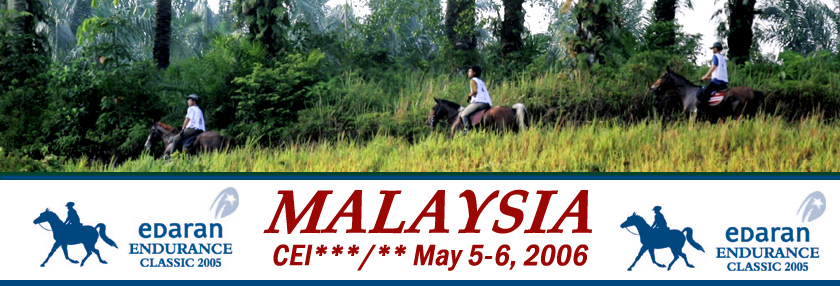
Kuala Lumpur, 18 April 2006-
Edaran Endurance Classic 2006
RIDE THE CLASSIC AGAIN!
Malaysia's premier and most anticipated endurance event is back! The Edaran Endurance Classic is back for its fourth year running after succeeding to catch the interest and attention of international riders in its 2005 event.
The event organized by Edaran Digital Systems Berhad has continued to gain recognition among endurance circles worldwide ever since it was inaugurated in 2003. In 2005, the Event was graced by World Endurance Championship's Gold Medalist HH Sheikh Hazza bin Sultan Al-Nahyan and his brother HH Sheikh Khaled Sultan who were here with the endurance riders of W'rsan Stables of Dubai.
Edaran Endurance Classic 2006 will be held at the grounds of ar-Raudhah Equine Centre, 40 minutes drive from Kuala Lumpur, Selangor, from 5-7 May.
The Event this year will feature three competition rides and one non-competitive 15KM guided ride. The main competition ride will be the FEI-CEI 3 Star 120Km Ride, a distance in keeping with the standards of the World Endurance Championship.
A second ride category in the Edaran Endurance Classic 2006 is the 80km Ride, a ride category for endurance riders training for longer distances; while a third category yet, is the 40km Ride, a shorter training ride for newly initiated endurance riders.
A total of RM45,000 in prize money stands to be won.
Endurance Riding - Focus on Malaysia
The sport of endurance riding has taken on greater significance in light of Malaysia being given the prestigious honour by the Federation Equestre Internationale (FEI), the world governing body for equestrian sports, to host the next World Cup of Endurance Riding - the World Endurance Championship 2008 [WEC 2008]. Over the next three years, right up till WEC 2008 in August 2008 endurance riding and Malaysia will become the focus.
"We are tremendously excited by the fact that the WEC 2008 will be held in Malaysia. It is a milestone happening for our country and a major boost for the sport of endurance riding. Endurance riding in Malaysia is different from riding in Europe or the Middle East region; and it presents riders a unique set of challenges in terms of the terrain and weather. We believe that endurance riders, both local and international, aiming to participate in the prestigious WEC 2008 will seek out opportunities in Malaysia to train and build up their endurance skills for the 2008 Event. The Edaran Endurance Classic which has come to be recognized as one of the country's better organized endurance events is one such opportunity," said Dato' Abdul Hamid Mustapha, the Organising Chairman of Edaran Endurance Classic 2006.
"We hope that with the Edaran Endurance Classics, we shall be able to assist in the building up to WEC 2008 by providing the opportunities for Malaysian and international endurance riders to train and familiarize themselves and their horses with the riding conditions in Malaysia," added Dato' Hamid.
Sports Tourism
The Edaran Endurance Classic has raised some degree of international interest and awareness of endurance riding in Malaysia through the publicity of the event since the inaugural event in 2003.
"We believe that like most international sports, endurance riding has the potential to contribute to our country's tourism industry. It is a sport enjoyed by adventurous individuals who are inclined to travel to various ride venues to experience riding in different settings. Malaysia's successful bid to host the WEC 2008 speaks volumes for our country as a recognized venue for world sports events. We have to our country's credit, successfully hosted world sports events as Formula 1, Tour de Langkawi and the Commonwealth Games. This year alone, we have two major world equestrian events scheduled in Malaysia, namely the World Cup Show Jumping Final and the FEI General Assembly, both of which will be taking place over the next week. Such momentum is good for our tourism industry and we hope to be able to play our part in contributing to building up Malaysia as a preferred world sports events venue," said Dato' Hamid Mustapha.
Young Riders
In its continuing efforts to promote the sport of endurance riding among the younger generation, the Edaran Endurance Classic 2006 will feature a Young Riders Category - a non-competitive guided ride over a distance of 15km, within the grounds of ar-Raudhah Equine Centre.
"The sport of endurance riding is ideal as a sport to promote appreciation of the environment as well as the disciplines of respect and perseverance among our young people. We hope that many more young enthusiasts will join us this year to try out this healthy and noble sport," said Dato' Hamid.
Edaran Digital Systems Berhad and Endurance Riding
The Edaran Endurance Classic is an event organized and sponsored by Edaran Digital Systems Berhad, a company involved in the provision of systems integration services and smart technology solutions. The Company has chosen to champion the promotion and development of the sport of endurance riding in Malaysia because Edaran Digital Systems Berhad identifies and shares the core values and qualities of the sport, namely discipline, respect and perseverance. As a Company that believes in the corporate duty of contributing and giving back to the society, Edaran Digital System has chosen to do so through bringing this healthy and enjoyable sport to more Malaysians through the Edaran Endurance Classic events.
Pivotal Support of The Equestrian Fraternity
As in the previous years. the support and assistance of Malaysia's equestrian fraternity especially the Equestrian Association of Malaysia (EAM), the Malaysian Endurance Riders Society (MERS) Malaysian Equine Council (MEM) as well as the encouragement and support of the Ministry of Sports have been pivotal to the organization of the Edaran Endurance Classic.
"We want to especially thank the EAM, MERS and the MEM for providing us with the assistance and support without which we would not have been able to organize the event with a good degree of success over the last three years of its running. The support of the fraternity is crucial in a sport that requires us to follow the strict statutes and regulations of the FEI.. Indeed it is our hope that we will continue to receive the commitment of all these bodies so that together we can successfully and effectively build up the sport of endurance riding in Malaysia. We believe Malaysia's hosting of the WEC 2008 will give the sport the much needed push and impetus to bring it to a higher level of participation and sporting excellence in Malaysia," said Dato' Hamid Mustapha.
Edaran Endurance Classic 2006 - Programme
The Edaran Endurance Classic 2006 will begin with final registration of participants and veterinary check of the horses on Friday, 5 May.
The main competition ride, the 120KM will be flagged off the following day, Saturday, 6 May at 10.30 pm followed by the flag -off of the 80KM ride at 12 midnight. The participants of the 120KM ride category are expected to complete the ride by 10.00 am on Sunday, 7 May.
On 7 May, the 40KM will be flagged-off at 7.00am followed by the flag-off of the 15KM Young Riders' Category. The Prize Giving Ceremony will be at 4.30pm, after the vet gate closes.
Interested participants for all Ride Categories can contact :
The Secretariat,
Edaran Endurance Classic 2006.
Tel: 603-9206 7200 Fax: 603- 92843531
Contact: Jefri Taharin
You may also log onto our website at www.edaranendurance.com for more information.
--------------------------------------------------------------------------------
Issued by:
Publicity and Promotions Desk
Edaran Endurance Classic 2006
Tel: 603 9206 7200 Fax: 603 9200 4629
Contact: Barbara Boey or Rohana Laksamana
Return to Edaran Classic 2006
http://english.bna.bh/?ID=43956
date: 20 04, 2006
MANAMA, APRIL. 20, (BNA) UNDER THE PATRONAGE OF HIS MAJESTY KING HAMAD BIN ISA AL KHALIFA, HIS MAJESTY THE KING'S ENDURANCE RACING CHAMPIONSHIP WAS FLAGGED OFF.
A TOTAL OF 135 RIDERS FROM VARIOUS COUNTRIES ARE TAKING PART IN THE 130 KILOMETERS SENIOR RACE AND 120 KILOMETERS JUNIOR RACE. SOME OF THE COUNTRIES TAKING PART IN THE RACE ARE BAHRAIN, UAE, SAUDI ARABIA, KUWAIT AND QATAR. UPON THE ARRIVAL OF HM THE KING TO THE ENDURANCE VILLAGE HE WAS WELCOMED BY PRESIDENT OF THE BAHRAIN ROYAL EQUESTRIAN AND ENDURANCE FEDERATION (BREEF), SHAIKH NASSER BIN HAMAD AL KHALIFA, FIRST DEPUTY PRESIDENT, SHAIKH KHALID BIN HAMAD AL KHALIFA, HEAD OF THE ENDURANCE COMMITTEE, SHAIKH FAISAL BIN RASHID AL KHALIFA AND A NUMBER OF OFFICIALS FROM THE ORGANIZING COMMITTEE. THEN HM THE KING WATCHED PART OF THE RACE AFTER WHICH HE CONGRATULATED UAE'S SHAIKH HAZA'A BIN SULTAN BIN ZAYED AL NAHYAN ON CLINCHING HM THE KING'S ENDURANCE CUP AND CONGRATULATED THE REST OF THE RIDERS WISHING THEM FUTURE SUCCESS IN OTHER CHAMPIONSHIPS. HE ALSO AFFIRMED THAT THE PARTICIPATION OF GCC RIDERS WITH THEIR FELLOW RIDERS IN BAHRAIN CREATES AN APPROPRIATE OPPORTUNITY TOWARDS FURTHER STRENGTHENING COOPERATION AMONG GCC YOUTH, WHICH IN ITS TURN HELPS ELEVATE THE STANDARDS OF THE SPORT. HM THE KING ALSO STRESSED ON THE EFFORTS EXERTED BY BREEF TO ORGANIZE THIS CHAMPIONSHIP IN THE BEST POSSIBLE WAY AND IN PROVIDING ALL THE SUPPORT AND ASSISTANCE TO THE PARTICIPATING RIDERS. HE ALSO WISHED THEM CONTINUED SUCCESS IN ACHIEVING THEIR ASPIRED GOALS AND OBJECTIVES. MEANWHILE, AL AREEN RESORT CHAIRMAN, SHAIKH AHMED BIN ALI AL KHALIFA, HAD EARLIER FLAGGED OFF THE START OF THE RACE. SHAIKH HAZA'A TOOK FIRST PLACE CLINCHING THE CHAMPIONSHIP CUP, WHILE HIS COUNTRYMAN, YOUSIF AL BALUCHI CAME IN SECOND AND SHAIKH KHALID BIN SULTAN AL NAHYAN CAME IN THIRD. THE JUNIORS CATEGORY WAS WON BY UAE RIDER, AMEER HUSSAIN AL BALUCHI, SECOND CAME BAHRAIN RIDER, SHAIKHA NAJLA BINT SALMAN BINT SAQER AL KHALIFA AND THIRD WAS SHAIKH SAQER BIN KHALID AL KHALIFA.
MANAMA, APRIL. 20, (BNA) UNDER THE PATRONAGE OF HIS MAJESTY KING HAMAD BIN ISA AL KHALIFA, HIS MAJESTY THE KING'S ENDURANCE RACING CHAMPIONSHIP WAS FLAGGED OFF.
A TOTAL OF 135 RIDERS FROM VARIOUS COUNTRIES ARE TAKING PART IN THE 130 KILOMETERS SENIOR RACE AND 120 KILOMETERS JUNIOR RACE. SOME OF THE COUNTRIES TAKING PART IN THE RACE ARE BAHRAIN, UAE, SAUDI ARABIA, KUWAIT AND QATAR. UPON THE ARRIVAL OF HM THE KING TO THE ENDURANCE VILLAGE HE WAS WELCOMED BY PRESIDENT OF THE BAHRAIN ROYAL EQUESTRIAN AND ENDURANCE FEDERATION (BREEF), SHAIKH NASSER BIN HAMAD AL KHALIFA, FIRST DEPUTY PRESIDENT, SHAIKH KHALID BIN HAMAD AL KHALIFA, HEAD OF THE ENDURANCE COMMITTEE, SHAIKH FAISAL BIN RASHID AL KHALIFA AND A NUMBER OF OFFICIALS FROM THE ORGANIZING COMMITTEE. THEN HM THE KING WATCHED PART OF THE RACE AFTER WHICH HE CONGRATULATED UAE'S SHAIKH HAZA'A BIN SULTAN BIN ZAYED AL NAHYAN ON CLINCHING HM THE KING'S ENDURANCE CUP AND CONGRATULATED THE REST OF THE RIDERS WISHING THEM FUTURE SUCCESS IN OTHER CHAMPIONSHIPS. HE ALSO AFFIRMED THAT THE PARTICIPATION OF GCC RIDERS WITH THEIR FELLOW RIDERS IN BAHRAIN CREATES AN APPROPRIATE OPPORTUNITY TOWARDS FURTHER STRENGTHENING COOPERATION AMONG GCC YOUTH, WHICH IN ITS TURN HELPS ELEVATE THE STANDARDS OF THE SPORT. HM THE KING ALSO STRESSED ON THE EFFORTS EXERTED BY BREEF TO ORGANIZE THIS CHAMPIONSHIP IN THE BEST POSSIBLE WAY AND IN PROVIDING ALL THE SUPPORT AND ASSISTANCE TO THE PARTICIPATING RIDERS. HE ALSO WISHED THEM CONTINUED SUCCESS IN ACHIEVING THEIR ASPIRED GOALS AND OBJECTIVES. MEANWHILE, AL AREEN RESORT CHAIRMAN, SHAIKH AHMED BIN ALI AL KHALIFA, HAD EARLIER FLAGGED OFF THE START OF THE RACE. SHAIKH HAZA'A TOOK FIRST PLACE CLINCHING THE CHAMPIONSHIP CUP, WHILE HIS COUNTRYMAN, YOUSIF AL BALUCHI CAME IN SECOND AND SHAIKH KHALID BIN SULTAN AL NAHYAN CAME IN THIRD. THE JUNIORS CATEGORY WAS WON BY UAE RIDER, AMEER HUSSAIN AL BALUCHI, SECOND CAME BAHRAIN RIDER, SHAIKHA NAJLA BINT SALMAN BINT SAQER AL KHALIFA AND THIRD WAS SHAIKH SAQER BIN KHALID AL KHALIFA.
Tuesday, April 18, 2006
AERC Reports Record Numbers for Multi-Day Events
Equestrian News Release
AUBURN, Ca. ? Faced with the high price of fuel, more endurance riders are participating in multi-day events as a way to get more miles for their money, the American Endurance Ride Conference (AERC), the governing body for endurance riding in the United States, reports.
?In today?s age of increased fuel and other costs, the multi-day ride is the best value going for endurance riders,? says past AERC President Randy Eiland. ?Instead of competing just one day, the multi-day ride allows the rider to participate in three or more endurance rides for the cost of only one trip.?
Participation in multi-day events has increased almost 13 percent per year from 1996 to 2005, according to AERC Vice President Michael Maul. ?The growth rate for multi-day rides is more than four times our annual membership growth of 3.1 percent,? says Maul.
In 2005, AERC recorded 4,341 entries in 34 different multi-day events representing 115 days of competition.
The multi-day event, or Pioneer Ride, is typically three to five days in length, and competitors ride 50 to 55 miles each day. The total minimum distance for a Pioneer Ride is 155 miles. While some opt to ride a different horse each day, many strive to complete the entire event?sometimes up to 250 miles total?on the same horse. Because of this, the atmosphere of the multi-day event is relaxed, and riders place more emphasis on finishing the day?s ride, rather than winning, thus providing testament to AERC?s motto, ?To Finish is to Win.?
Karen Chaton of Gardnerville, Nevada, says she enjoys multi-day rides because it gives her the chance to learn a lot about her horse and herself.
?I find multi-days to be the greatest challenge, and the most rewarding experience for me is to complete a five-day ride on the same horse,? says Chaton, who has twice won the XP Gold Medal Award for completing all five AERC-sanctioned XP multi-day rides (http://www.xprides.com) in one year?two three-day events and three five-day events totaling 1,060 miles?with her Arabian gelding, Granite Chief+/. ?The riders are more relaxed, and everybody tends to focus on experiencing the trail, their horse and their friends, which is more like family. It gets you away from the real world and puts you in an atmosphere that allows you to succeed or fail, while at the same time allowing you to learn so much,? says Chaton.
Eiland, who has been managing multi-day rides since 1988 and currently manages several three-day, 165-mile rides each year, says that his events in southern New Mexico attract riders from as far as Indiana and Canada. ?Pioneer Rides have proven both their worth and their ability to excite the membership,? he says.
The Pioneer Ride was born in 1982, when Tom Bowling was granted sanctioning by AERC for a four-day ride to help preserve historic trails. The following year, Dave Nicholson, D.V.M., who currently manages five multi-day rides each year, hosted the first of the five-day, point-to-point Pony Express Rides.
?Dave Nicholson?s ride captured the imagination of a few AERC members and proved to be a successful event,? says Eiland. ?From those early beginnings, more and more AERC members began to catch the multi-day ride excitement. The original Pioneer Rides were point-to-point rides over four or more days. In the mid-1990s, the AERC Board of Directors approved three-day events as Pioneer Rides to encourage more participation and opportunity for awards.
?This made the event available to a wider range of riders,? says Eiland. ?When multi-day rides began utilizing one base camp, the floodgate was opened. Today, the Pioneer Ride is one of the most popular and well-attended events that AERC sanctions.?
Says Chaton, ?I like how many of the multi-day rides are laid out, with one large loop out of camp. ?You get out there in some of the most beautiful country imaginable.?
AUBURN, Ca. ? Faced with the high price of fuel, more endurance riders are participating in multi-day events as a way to get more miles for their money, the American Endurance Ride Conference (AERC), the governing body for endurance riding in the United States, reports.
?In today?s age of increased fuel and other costs, the multi-day ride is the best value going for endurance riders,? says past AERC President Randy Eiland. ?Instead of competing just one day, the multi-day ride allows the rider to participate in three or more endurance rides for the cost of only one trip.?
Participation in multi-day events has increased almost 13 percent per year from 1996 to 2005, according to AERC Vice President Michael Maul. ?The growth rate for multi-day rides is more than four times our annual membership growth of 3.1 percent,? says Maul.
In 2005, AERC recorded 4,341 entries in 34 different multi-day events representing 115 days of competition.
The multi-day event, or Pioneer Ride, is typically three to five days in length, and competitors ride 50 to 55 miles each day. The total minimum distance for a Pioneer Ride is 155 miles. While some opt to ride a different horse each day, many strive to complete the entire event?sometimes up to 250 miles total?on the same horse. Because of this, the atmosphere of the multi-day event is relaxed, and riders place more emphasis on finishing the day?s ride, rather than winning, thus providing testament to AERC?s motto, ?To Finish is to Win.?
Karen Chaton of Gardnerville, Nevada, says she enjoys multi-day rides because it gives her the chance to learn a lot about her horse and herself.
?I find multi-days to be the greatest challenge, and the most rewarding experience for me is to complete a five-day ride on the same horse,? says Chaton, who has twice won the XP Gold Medal Award for completing all five AERC-sanctioned XP multi-day rides (http://www.xprides.com) in one year?two three-day events and three five-day events totaling 1,060 miles?with her Arabian gelding, Granite Chief+/. ?The riders are more relaxed, and everybody tends to focus on experiencing the trail, their horse and their friends, which is more like family. It gets you away from the real world and puts you in an atmosphere that allows you to succeed or fail, while at the same time allowing you to learn so much,? says Chaton.
Eiland, who has been managing multi-day rides since 1988 and currently manages several three-day, 165-mile rides each year, says that his events in southern New Mexico attract riders from as far as Indiana and Canada. ?Pioneer Rides have proven both their worth and their ability to excite the membership,? he says.
The Pioneer Ride was born in 1982, when Tom Bowling was granted sanctioning by AERC for a four-day ride to help preserve historic trails. The following year, Dave Nicholson, D.V.M., who currently manages five multi-day rides each year, hosted the first of the five-day, point-to-point Pony Express Rides.
?Dave Nicholson?s ride captured the imagination of a few AERC members and proved to be a successful event,? says Eiland. ?From those early beginnings, more and more AERC members began to catch the multi-day ride excitement. The original Pioneer Rides were point-to-point rides over four or more days. In the mid-1990s, the AERC Board of Directors approved three-day events as Pioneer Rides to encourage more participation and opportunity for awards.
?This made the event available to a wider range of riders,? says Eiland. ?When multi-day rides began utilizing one base camp, the floodgate was opened. Today, the Pioneer Ride is one of the most popular and well-attended events that AERC sanctions.?
Says Chaton, ?I like how many of the multi-day rides are laid out, with one large loop out of camp. ?You get out there in some of the most beautiful country imaginable.?
Subscribe to:
Posts (Atom)
China Equestrian endurance riding competition opens in north China county
BastillePost.com - Full Article 2026-07-19 China's 2026 Equestrian Endurance Riding Competition opened in Fengning Manchu Autonomous...

-
Inside.fei.org 17 December 2020 The FEI Board took a series of key decisions on allocation, cancellation, and reopening of bids for FEI C...
-
 Michael Pollard was one of the four winners of the 2025 Mongol Derby (Kathy Gabriel) Ca.News.yahoo.com - Full Article Annabel Grossman ...
 -
BNA.bh - Full Article 17 Aug 2025 London, Aug. 17 (BNA): His Highness Shaikh Nasser bin Hamad Al Khalifa, Representative of His Majes...
