
February 4 2017
The German Endurance Federation sent a letter to the FEI regarding international endurance horse welfare issues.
The letter states:
"We- the Association of German Endurance Riders and Endurance Horse Drivers, Verein Deutscher Distanzreiter und -Fahrer e.V. – hereby disassociate ourselves from every incident connected with endurance rides in which our equine partner is not treated strictly according to the basic standards of animal welfare.
We urge the FEI, using every available means, that all respective incidents worldwide are thoroughly investigated and that the resulting findings are immediately made public and that strict penalties are imposed on those responsible.
It is of paramount importance that endurance riding and animal welfare go hand in hand if we are to ensure the future of our sport."
The letter can be seen here:
http://www.vdd-aktuell.de/
Wednesday, February 08, 2017
Norway Boycotts Group 7 Endurance Rides
8 February 2017
On the basis of a number of negative events in the UAE over the past four weeks with several doping cases and deaths among horses, and stating that horse welfare is of primary concern,
the NRYF (Norwegian Federation) has announced that beginning today, Norwegian endurance riders will not compete in any Group 7 countries.
The Danish and the Swedish federations announced the same decision over the previous day.
Read the full text here:
http://www.hestesport.no/web.aspx?page=105234&newsarticle=55749
On the basis of a number of negative events in the UAE over the past four weeks with several doping cases and deaths among horses, and stating that horse welfare is of primary concern,
the NRYF (Norwegian Federation) has announced that beginning today, Norwegian endurance riders will not compete in any Group 7 countries.
The Danish and the Swedish federations announced the same decision over the previous day.
Read the full text here:
http://www.hestesport.no/web.aspx?page=105234&newsarticle=55749
Statement from Endurance GB and the BEF regarding welfare concerns in the UAE
08 February 2017
The British Equestrian Federation (BEF) and Endurance GB (EGB) have jointly written to the FEI to express their profound concerns about the further catastrophic incidents to horses competing in the UAE and to call on the FEI to take firm and prompt action to address the recurrence of chronic injuries and unacceptable practices at both Dubai and Al Wathba venues.
EGB have also made it clear that they will not be submitting entries to the forthcoming HH President of the UAE Cup and the Crown Prince Cup in the light of these concerns. In addition, EGB will be writing to British riders based in the Middle East to urge them not to take part in events in Dubai and Al Wathba until confidence in the welfare procedures in place has been restored. EGB is currently considering withdrawing ‘No Objection Certificates’ from those who do intend to compete.
The BEF and EGB recognises the efforts of Sheikh Sultan Bin Zayed Al Nayhan and the FEI to improve horse welfare in Endurance events through the development of the ‘Boudheib’ protocols where efforts have been made to tailor competition to the challenging natural terrain and environment, and to protect horses from the their impact by prescribing speed and recovery parameters with these in mind. We believe there is the scope for these to be adopted more broadly in the Middle East and in similarly stretching geographies. There is also a need for greater scrutiny of training practices and the degree to which these contribute to the development of pre-existing conditions which lead to chronic injuries in competition.
We recognise that the FEI is taking steps to investigate these extremely distressing events, and to develop measures to address the issues leading to them in the interests of equine welfare. With this in mind, we support their efforts to work with the UAE Federation as a force for change, rather than to separate from them. Nonetheless we believe a visible and decisive step needs to be taken in banning riders and trainers found to be involved in malpractices as a demonstration that these will not be tolerated and that equine welfare is of paramount concern in sustainable competition.
The British Equestrian Federation (BEF) and Endurance GB (EGB) have jointly written to the FEI to express their profound concerns about the further catastrophic incidents to horses competing in the UAE and to call on the FEI to take firm and prompt action to address the recurrence of chronic injuries and unacceptable practices at both Dubai and Al Wathba venues.
EGB have also made it clear that they will not be submitting entries to the forthcoming HH President of the UAE Cup and the Crown Prince Cup in the light of these concerns. In addition, EGB will be writing to British riders based in the Middle East to urge them not to take part in events in Dubai and Al Wathba until confidence in the welfare procedures in place has been restored. EGB is currently considering withdrawing ‘No Objection Certificates’ from those who do intend to compete.
The BEF and EGB recognises the efforts of Sheikh Sultan Bin Zayed Al Nayhan and the FEI to improve horse welfare in Endurance events through the development of the ‘Boudheib’ protocols where efforts have been made to tailor competition to the challenging natural terrain and environment, and to protect horses from the their impact by prescribing speed and recovery parameters with these in mind. We believe there is the scope for these to be adopted more broadly in the Middle East and in similarly stretching geographies. There is also a need for greater scrutiny of training practices and the degree to which these contribute to the development of pre-existing conditions which lead to chronic injuries in competition.
We recognise that the FEI is taking steps to investigate these extremely distressing events, and to develop measures to address the issues leading to them in the interests of equine welfare. With this in mind, we support their efforts to work with the UAE Federation as a force for change, rather than to separate from them. Nonetheless we believe a visible and decisive step needs to be taken in banning riders and trainers found to be involved in malpractices as a demonstration that these will not be tolerated and that equine welfare is of paramount concern in sustainable competition.
Tuesday, February 07, 2017
Sweden and Denmark Will No Longer Send Endurance Riders to UAE
February 7 2017
Af of today, the Swedish Equestrian Federation made the decision to suspend, "until further notice," sending Swedish horses and riders to compete in the Group VII countries in the Middle East. The SEF also announced today that "until further notice" they
The Danish Equestrian Federation also announced this morning its decision that no Danish riders would start in the Group VII countries.
Last year, the SEF, together with organizations in the other Nordic countries agreed disallow competition in the Group VII countries on borrowed horses, although they were allowed to train and qualify and enter their own horses. This is no longer the case.
The original article is here:
http://www.tidningenridsport.se/Tavling/Distansritt/2017/2/Inga-mer-svenskar-till-skandal-landerna/
Af of today, the Swedish Equestrian Federation made the decision to suspend, "until further notice," sending Swedish horses and riders to compete in the Group VII countries in the Middle East. The SEF also announced today that "until further notice" they
The Danish Equestrian Federation also announced this morning its decision that no Danish riders would start in the Group VII countries.
Last year, the SEF, together with organizations in the other Nordic countries agreed disallow competition in the Group VII countries on borrowed horses, although they were allowed to train and qualify and enter their own horses. This is no longer the case.
The original article is here:
http://www.tidningenridsport.se/Tavling/Distansritt/2017/2/Inga-mer-svenskar-till-skandal-landerna/
Monday, February 06, 2017
UAE: BOUDHEIB: FEEDBACK AND CONTINUOUS INNOVATIONS
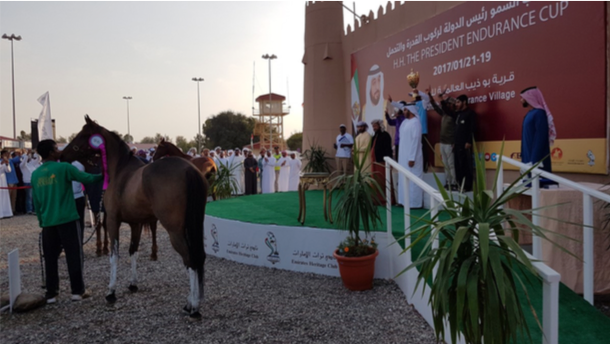 Prize giving ceremony with no longer "invisible" horses.
2 February 2017
by François Kerboul
FEI 4* Judge, TD & CD
Architect dplg
Now the international specialized press does not any longer use expressions like "group VII" or "UAE" as being entities one cannot divide. Indeed group VII includes very different countries such as the Persian Gulf Emirates, Tunisia, Algeria or Morocco which have nothing in common in the field of equestrian disciplines ...
From now on the press clearly makes the difference between Dubai (DIEC), Al Wathba (ADEC) and Boudheib (BIEV) as it does for all the other countries because it has noticed that various types of management exist. It acknowledges that it has become impossible to consider them as being part of an indivisible entity. It is important and this is not the least victory of Boudheib Endurance.
PRECISIONS ON THE PRESIDENT CUP RIDES
The President Cup competitions for Ladies, Horses Owned by Private Owners and Young Riders are traditionally held in Boudheib (BIEV) while the President Cup for Seniors is managed by ADEC (Al Wathba).
This year the winner of the President Cup for Young Riders (CEIYJ 2* 120km – 21 01 2017) finished the competition with an average speed (FEI) of 18.75 km/h. This speed is relatively common in Europe and elsewhere but it had never been seen before in the region. If we compare this result with the former years, one's note that the average speed of the winners from 2010 to 2015 was 26.61 km/h reaching 28.58 km/h in 2015. We also note that they did increase every season, 2010 being "modestly" 25.65 km/h.
It is also interesting to note that the winner did not exceed 21.53 km/h on his fastest phase. On the contrary the 3rd one ended his ride with a top phase speed of 34.02 km/h, which in 2013means a difference of almost 12.50 km/h with today's.
The speed decrease is significant. It is remarkable moreover when one knows that the President Cup for Young Riders is a kind of explosive cocktail since they are speed lovers, have top quality horses and are eager to win the prizes (even if 70% are for the BECA ranking).
Speed breaks horses. A recent study done by the École Nationale Vétérinaire de Maison-Alfort 's researchers (National Veterinary School of Maison-Alfort – France) based on the ATRM database confirms it once more1:
• Speed is a major factor of risk.
• The presentation time is an important sign of a good condition.
In conclusion of their study they advocate among other solutions:
• to slow down the horses during the competitions;
• to reduce the presentation time.
This is exactly what the Boudheib Protocol (BECA) has been doing for more than one year with convincing results.
The speed of the CEIYJ 2* of the President Cup is low but at the same time the percentage of qualified horse is correct however inferior to the ones of the former CEIs of the season held under the same protocol in Boudheib (respectively 79% and 61%). The noticeable difference is obviously due to the distance since those CEIs were 80 km long.
The distance factor was obviously coupled with a relatively bad management on the tracks. Numerous riders were seen galloping on the natural track as they always do on the prepared "traditional" ones. It increased their horses' tiredness as a result. That is why an unusual number of horses were disqualified due to the incapacity to be presented in time (10%), added to gait irregularities (14.5%) and horses declared "metabolic" (26.9%). One has to note that around half of the latter were above the 56 bpm authorized. 11.6% of the horses were retired by their riders, trainers and/or owners because, if they were, at that time, in good condition they were not fit enough to continue in the same condition according to the BECA parameters.
So one can estimate that around 30% of the horses did not finish the ride, either because they could not match the Boudheib Protocol parameters or because their riders, trainers or owners wished to preserve them...
Read the full article here
Saturday, February 04, 2017
FEI pushes again to rein in endurance in the UAE
Horsetalk.co.nz - Full Article
February 4, 2017
Horsetalk.co.nz
The FEI is promising it will fast-track new rules to protect endurance horses if upcoming scientific findings identify a need, as it tackles ongoing problems within the sport in the United Arab Emirates (UAE).
Endurance in the UAE remains mired in controversy after a series of horse deaths this season and a string of positive drug tests under the FEI’s anti-doping rules.
Ongoing problems within UAE endurance in recent years have centered around horse welfare issues. The region’s fast desert courses, substantial prizes and jockey-style riders have contributed to the problems, in the eyes of some critics.
The region has also faced condemnation at times over what some consider to be a loose interpretation of the sport’s rules.
Now, FEI Secretary General Sabrina Ibáñez has provided an overview of measures to be implemented by both the FEI and the UAE Equestrian Federation to address what the world governing body calls serious horse welfare issues in UAE Endurance...
Read more here:
http://www.horsetalk.co.nz/2017/02/04/fei-endurance-uae/#axzz4Xkc4DfMb
February 4, 2017
Horsetalk.co.nz
The FEI is promising it will fast-track new rules to protect endurance horses if upcoming scientific findings identify a need, as it tackles ongoing problems within the sport in the United Arab Emirates (UAE).
Endurance in the UAE remains mired in controversy after a series of horse deaths this season and a string of positive drug tests under the FEI’s anti-doping rules.
Ongoing problems within UAE endurance in recent years have centered around horse welfare issues. The region’s fast desert courses, substantial prizes and jockey-style riders have contributed to the problems, in the eyes of some critics.
The region has also faced condemnation at times over what some consider to be a loose interpretation of the sport’s rules.
Now, FEI Secretary General Sabrina Ibáñez has provided an overview of measures to be implemented by both the FEI and the UAE Equestrian Federation to address what the world governing body calls serious horse welfare issues in UAE Endurance...
Read more here:
http://www.horsetalk.co.nz/2017/02/04/fei-endurance-uae/#axzz4Xkc4DfMb
Friday, February 03, 2017
Nine Suspensions in Dubai – But is it Quite What it Seems?
Horse-canada.com - Full Article
Cuckson Report | February 3, 2017
Sceptic has become my middle name. Ideally, I would prefer to think that today’s nine Dubai rider/trainer provisional suspensions for doping offences in endurance plus news of the Emirates Equestrian Federation’s (EEF) plans to reduce fatalities represent a turning point in the UAE crisis.
But while it is good news for the horses now spared contact with this unlovely bunch of miscellaneous offenders, I regretfully predict the reprieve won’t last long.
Looking at the prohibited substances involved, a contaminated-feeds defence has a reasonable chance of reduced or minimal sanctions. A hapless forage manufacturer can surely be induced to put his hands up to it – after all, this is Dubai we are talking about. And if not he, the trainers implicated might agree take the full rap, especially those with prior “form” for doping and especially because the Maktoums show fierce loyalty to disgraced employees and find them work elsewhere in the family empire.
As for the EEF’s pledge to investigate this or demand that from their stakeholders, I hope the FEI doesn’t put too much trust in second-hand reports. FEI officials are powerless to act on the rule violations that happen right under their noses at rides, so how much stock can it realistically place on information from EEF who, in turn, can only write down in good faith what they are told by the very same barns stables so often in the frame for wrongdoing?
Yes, it is progress, but only in dolly steps. The FEI says there is a much more hands-on and “transparent” approach by the new management of the EEF. I too detected an inclination to co-operate more, at least from the Abu Dhabi end, when I visited the Al Wathba venue in November. Among other bad eggs, EEF appears to have dispensed with the staffers tied-up with the mass fraud of CEI results in the “phantom rides” scandal on 2015.
But the new measures listed today – tougher sanctions for horse killers; and an in-depth study into why bones break under stress (something breathtakingly obvious to those of us with no medical training) etc, etc – bear a startling resemblance to suggestions made at the FEI endurance “crisis” conference in Lausanne exactly three years ago (February 9, 2014). How many of those were adopted? Er, none. And how efficacious were the recommendations of the Endurance Strategic Planning Group (ESPG) which was the Big Thing of 2013-2014? Not very. If memory serves me right, the ESPG cost the FEI Euros 500,000. What a bargain that wasn’t...
Read more here:
https://www.horse-canada.com/cuckson-report/nine-suspensions-in-dubai-but-is-it-quite-what-it-seems/
Cuckson Report | February 3, 2017
Sceptic has become my middle name. Ideally, I would prefer to think that today’s nine Dubai rider/trainer provisional suspensions for doping offences in endurance plus news of the Emirates Equestrian Federation’s (EEF) plans to reduce fatalities represent a turning point in the UAE crisis.
But while it is good news for the horses now spared contact with this unlovely bunch of miscellaneous offenders, I regretfully predict the reprieve won’t last long.
Looking at the prohibited substances involved, a contaminated-feeds defence has a reasonable chance of reduced or minimal sanctions. A hapless forage manufacturer can surely be induced to put his hands up to it – after all, this is Dubai we are talking about. And if not he, the trainers implicated might agree take the full rap, especially those with prior “form” for doping and especially because the Maktoums show fierce loyalty to disgraced employees and find them work elsewhere in the family empire.
As for the EEF’s pledge to investigate this or demand that from their stakeholders, I hope the FEI doesn’t put too much trust in second-hand reports. FEI officials are powerless to act on the rule violations that happen right under their noses at rides, so how much stock can it realistically place on information from EEF who, in turn, can only write down in good faith what they are told by the very same barns stables so often in the frame for wrongdoing?
Yes, it is progress, but only in dolly steps. The FEI says there is a much more hands-on and “transparent” approach by the new management of the EEF. I too detected an inclination to co-operate more, at least from the Abu Dhabi end, when I visited the Al Wathba venue in November. Among other bad eggs, EEF appears to have dispensed with the staffers tied-up with the mass fraud of CEI results in the “phantom rides” scandal on 2015.
But the new measures listed today – tougher sanctions for horse killers; and an in-depth study into why bones break under stress (something breathtakingly obvious to those of us with no medical training) etc, etc – bear a startling resemblance to suggestions made at the FEI endurance “crisis” conference in Lausanne exactly three years ago (February 9, 2014). How many of those were adopted? Er, none. And how efficacious were the recommendations of the Endurance Strategic Planning Group (ESPG) which was the Big Thing of 2013-2014? Not very. If memory serves me right, the ESPG cost the FEI Euros 500,000. What a bargain that wasn’t...
Read more here:
https://www.horse-canada.com/cuckson-report/nine-suspensions-in-dubai-but-is-it-quite-what-it-seems/
Subscribe to:
Comments (Atom)
Feed Manufacturer Joins Endurance GB for “Suitably Mounted” Welfare Initiative
April 9 2026 Endurance GB is pleased to announce that Baileys Horse Feeds will be supporting the organisation’s Suitably Mounted welfare...

-
Inside.fei.org 17 December 2020 The FEI Board took a series of key decisions on allocation, cancellation, and reopening of bids for FEI C...
-
 Michael Pollard was one of the four winners of the 2025 Mongol Derby (Kathy Gabriel) Ca.News.yahoo.com - Full Article Annabel Grossman ...
 -
BNA.bh - Full Article 17 Aug 2025 London, Aug. 17 (BNA): His Highness Shaikh Nasser bin Hamad Al Khalifa, Representative of His Majes...
